
Comprehensive Guide to ICD-10 Codes for Allergic Reactions
January 4, 2026
Mastering G47.33: Your Essential Guide to ICD-10 Coding for Obstructive Sleep Apnea (OSA)
January 4, 2026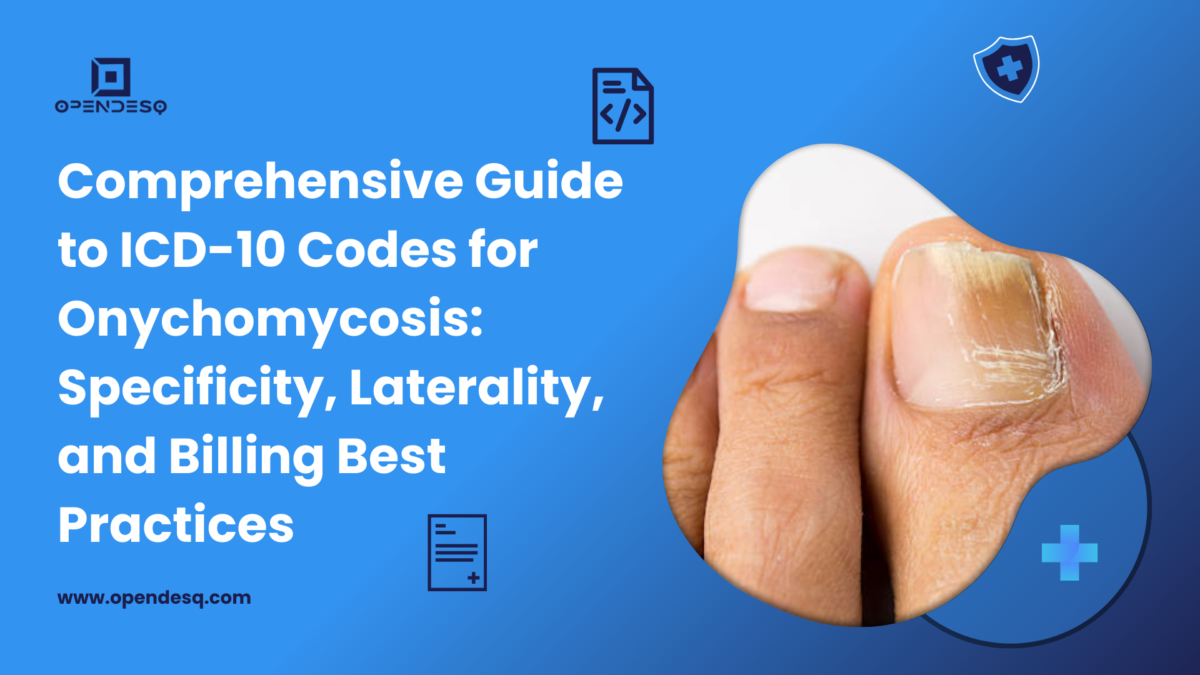
A Comprehensive Guide to Specificity, Laterality, and Billing Compliance
Introduction
If you work in medical billing, coding, or clinical documentation, you already know that onychomycosis is not a simple diagnosis to code. It is one of the most common nail conditions seen in dermatology, podiatry, and primary care, yet it continues to cause confusion, claim denials, and compliance risks. The challenge is not the diagnosis itself. The challenge lies in choosing the correct ICD-10 code, applying the right level of specificity, documenting laterality accurately, and accounting for related conditions that impact reimbursement.
What makes this even more difficult is the constant evolution of ICD-10-CM guidelines and payer specific requirements. A code that looks acceptable on the surface may fail during claim review if the documentation does not fully support it. Many practices lose revenue not because treatment was unnecessary, but because the coding was incomplete or not specific enough. Audits, delayed payments, and denials often trace back to small documentation gaps that could have been avoided.
This guide is designed to remove that uncertainty. You will learn how to code onychomycosis with confidence, precision, and compliance. We will walk through the correct ICD-10 codes, explain laterality rules in clear terms, show how to code associated conditions, and highlight documentation best practices that protect your practice financially. By the end, you will have a practical framework you can apply immediately to improve accuracy, reduce denials, and strengthen audit readiness.
Understanding Onychomycosis and Its Coding Imperative
What Is Onychomycosis
Onychomycosis is a fungal infection that affects the nail plate, the nail bed, or both. It is most commonly caused by dermatophytes, particularly tinea unguium, but yeasts and non dermatophyte molds may also be responsible. Clinically, it presents in several forms, including distal subungual onychomycosis, white superficial onychomycosis, proximal subungual onychomycosis, and candidal onychomycosis.
This condition is highly prevalent, especially among older adults, patients with diabetes, individuals with peripheral vascular disease, and those who are immunocompromised. While it may appear cosmetic at first glance, untreated onychomycosis can lead to pain, nail deformity, secondary bacterial infections, and functional impairment. In high risk patients, particularly those with diabetes, it can contribute to serious foot complications.
From a clinical standpoint, dermatology and podiatry consensus recognizes onychomycosis as a legitimate medical condition that often requires ongoing management. From a coding standpoint, however, its varied presentations demand careful documentation and precise ICD-10 code selection to reflect the true nature of the condition.
Why Accurate ICD-10 Coding Is Critical
Accurate ICD-10 coding for onychomycosis is not optional. It directly affects reimbursement, compliance, and patient care reporting. One of the most common pain points for billers and coders is the fear of claim denials due to vague or unsupported diagnoses. Using a generic code when a more specific one is available increases the likelihood of payer rejection.
Correct coding ensures that services rendered are reimbursed appropriately. Treatments such as antifungal therapies, nail debridement, or ongoing monitoring require medical necessity justification. ICD-10 codes play a central role in proving that necessity. When the diagnosis is accurately coded and fully supported by documentation, claims move through the system more smoothly.
Beyond billing, ICD-10 coding contributes to data accuracy across the healthcare system. Public health tracking, research, and quality reporting rely on precise diagnostic data. Misclassification of nail disorders can distort disease prevalence data and undermine reporting integrity.
Compliance is another major factor. Regulatory bodies such as the Centers for Medicare and Medicaid Services expect diagnoses to be coded according to official ICD-10-CM guidelines. Inaccurate or unsupported coding can trigger audits, recoupments, and penalties. Even unintentional errors can expose a practice to financial risk.
From a financial perspective, precise onychomycosis coding has a measurable impact. Practices that consistently code to the highest level of specificity experience fewer denials, faster payments, and improved revenue cycle performance. Accurate coding also reduces the administrative burden of rework and appeals, allowing staff to focus on efficiency rather than correction.
When onychomycosis is coded correctly, it benefits everyone involved. Patients receive appropriate care, providers maintain compliance, and practices protect their financial health.
Core ICD-10 Codes for Onychomycosis
A Definitive Guide to Accurate Code Selection
Correctly identifying the primary ICD-10 code for onychomycosis is the foundation of accurate billing and compliance. Many denials occur not because the diagnosis is wrong, but because the code chosen is too general or not supported by documentation. This section breaks down the most commonly used ICD-10 codes for onychomycosis, explains when to use each one, and clarifies how specificity and laterality affect code selection.
All codes discussed here align with the latest ICD-10-CM code structure and should always be validated against the most current official ICD-10-CM codebook.
Primary ICD-10 Codes and Their Descriptions
The table below outlines the core ICD-10 codes used in onychomycosis coding, along with practical guidance on usage and documentation requirements.
| ICD-10 Code | Description | Laterality and Specificity Notes |
| B35.1 | Tinea unguium (Onychomycosis) | This is the primary and most commonly used code for fungal nail infections. It does not include built in laterality. Documentation must clearly state whether fingernails or toenails are affected and whether the condition is left, right, bilateral, or unspecified. Often used alongside additional nail disorder codes when applicable. |
| B35.1 | Onychomycosis, unspecified nail(s), unspecified laterality | Used only when the provider documentation does not specify the affected nail or laterality. This code should be avoided whenever more detail is available, as it increases denial risk. |
| L60.2 | Onychogryphosis | Describes thickened, curved nails. This is not a fungal infection but frequently coexists with onychomycosis. Laterality is required and includes specific options for fingers, toes, unilateral, and bilateral involvement. Should be coded as a secondary diagnosis when onychomycosis is confirmed. |
| B49 | Mycosis, unspecified | Used only when the fungal type and site are not identified. This code is less specific than B35.1 and should be a last resort. |
| L60.9 | Disorder of nail, unspecified | Extremely broad and should only be used when no specific nail disorder is documented. Avoid when onychomycosis or another defined condition is confirmed. |
It is important to note that B35.1 remains the cornerstone code for onychomycosis. However, it relies heavily on supporting documentation to meet payer expectations. When additional nail changes or complications are present, secondary codes should be assigned to fully represent the patient’s condition.
Expert Tip
Always rely on the official ICD-10-CM codebook or CMS guidelines as your primary reference. Third party summaries are helpful, but final code selection should always be validated using authoritative sources.
Understanding Specificity and Laterality in Onychomycosis Coding
One of the most common sources of coding errors in onychomycosis is improper use of specificity and laterality. Payers expect coders to report the most detailed code supported by documentation. Generic codes signal incomplete records and often trigger denials or audits.
Why Specificity Matters
Specificity directly impacts claim acceptance. Codes that lack detail fail to clearly describe the patient’s condition. This creates uncertainty around medical necessity and treatment justification. When a more specific code is available and supported by documentation, it must be used.
Coding to the highest level of specificity improves reimbursement accuracy, reduces back and forth with payers, and strengthens compliance posture.
Expert Tip
Always code to the highest level of specificity available, including laterality and affected digits, when documented by the provider.
Laterality Rules Explained
Laterality describes which side of the body is affected. For nail conditions, this includes left, right, bilateral, or unspecified involvement. Some codes include laterality extensions, while others rely entirely on documentation to clarify laterality.
Left
Use when documentation clearly states the left hand or left foot is affected.
Right
Use when documentation specifies right sided involvement.
Bilateral
Use only when documentation explicitly confirms both sides are affected. Do not assume bilateral involvement.
Unspecified
Use only when documentation does not provide laterality details. This should be a last resort.
Expert Tip
When assigning codes for bilateral conditions, ensure documentation clearly supports both sides or use the designated bilateral code if available.
Fingernails vs Toenails
Another critical distinction is whether the infection involves fingernails or toenails. This affects code selection and documentation expectations. Some payers apply different coverage criteria based on nail location, especially for treatment justification.
Expert Tip
Always consider the site of infection. Fingernail and toenail involvement should be clearly documented and reflected in coding decisions.
Conceptual Interactive Decision Tree for Code Selection
To simplify code selection, many practices benefit from a structured decision making process. A conceptual decision tree for onychomycosis coding would follow these steps:
First, confirm the diagnosis. Is the condition confirmed as onychomycosis or tinea unguium?
Second, identify the site. Are fingernails, toenails, or both affected?
Third, determine laterality. Is the condition left sided, right sided, bilateral, or unspecified?
Fourth, assess associated nail conditions such as onychogryphosis.
Fifth, review documentation for co morbidities or complications that require additional codes.
This step by step approach reduces guesswork and promotes consistent, compliant coding across providers and billing teams.
Visual tools such as flowcharts embedded into internal coding resources or EHR systems can significantly improve accuracy and efficiency.
Navigating Complexities
Associated Conditions and Advanced Onychomycosis Coding
Onychomycosis rarely exists in isolation, especially in high risk patient populations. Many denials and underpayments occur because coders focus only on the fungal nail infection and overlook associated conditions that directly affect treatment decisions, medical necessity, and reimbursement. Accurate coding requires a complete clinical picture, not just a single diagnosis code.
This section explains how to identify and code common co morbidities, how to sequence primary and secondary diagnoses correctly, and why coding beyond B35.1 is essential for compliant and optimized billing.
Coding Associated Conditions and Secondary Diagnoses
Associated conditions are diagnoses that coexist with onychomycosis and influence patient management. When these conditions are documented, they must be coded in addition to the primary onychomycosis code.
The most frequently associated conditions include systemic diseases, vascular disorders, immune compromise, and secondary infections. These conditions often justify more intensive treatment, ongoing monitoring, or procedural interventions.
Common Co Morbidities Seen with Onychomycosis
Diabetes Mellitus
Patients with diabetes are at significantly higher risk for onychomycosis and its complications. When diabetes is documented, it should be coded using the appropriate category from E08 through E13, based on the type and cause of diabetes.
Examples include Type 2 diabetes with peripheral circulatory complications or neurological complications. These codes demonstrate increased medical necessity for treatment and follow up care.
Peripheral Vascular Disease
Reduced blood flow impairs nail growth and healing, making fungal infections more persistent. Conditions such as atherosclerosis of the extremities or chronic peripheral vascular disease should be coded when documented.
Immunosuppression
Patients with weakened immune systems due to conditions like HIV, cancer treatment, or chronic illness are more susceptible to fungal infections. Coding immunosuppression provides context for disease severity and treatment complexity.
Secondary Bacterial or Fungal Infections
Onychomycosis can lead to skin breakdown and secondary infections such as cellulitis. These conditions must be coded separately when present, as they significantly affect clinical management.
Expert Tip
Do not overlook coding associated risk factors or co morbidities that impact patient management and medical necessity. Comprehensive coding supports both care quality and reimbursement.
Beyond B35.1
Coding Co Morbidities and Complications Correctly
Relying solely on B35.1 can underrepresent the patient’s condition. Payers evaluate claims holistically, and incomplete coding may fail to justify the services provided.
Understanding Code Sequencing
The primary diagnosis is typically onychomycosis when it is the main reason for the encounter. Secondary diagnoses include co morbidities or complications that influence treatment.
For example, if a patient presents primarily for fungal nail treatment but also has diabetes with neuropathy, onychomycosis is coded first, followed by the appropriate diabetes and complication codes.
Correct sequencing improves claim clarity and aligns with ICD-10-CM guidelines.
Impact on Medical Necessity and Reimbursement
Coding co morbidities supports the medical necessity of antifungal therapy, debridement, or long term monitoring. Payers are more likely to approve services when the full risk profile is documented.
In high risk patients, failure to code associated conditions can result in denied claims, reduced reimbursement, or audit exposure.
Expert Tip
Comprehensive coding does not mean overcoding. It means accurately reflecting all documented conditions that affect patient care.
Practical Coding Examples for Associated Conditions
When onychomycosis is documented alongside other conditions, coding should clearly reflect the clinical scenario.
A patient with fungal infection of the toenails and Type 2 diabetes with peripheral circulatory complications should have both conditions coded. This demonstrates increased risk and supports the necessity of treatment.
A patient with onychomycosis and secondary cellulitis of the toe requires separate codes for both the fungal infection and the bacterial infection.
A patient undergoing chemotherapy who develops onychomycosis should have the fungal infection coded along with the appropriate code reflecting immunosuppression or treatment status, when documented.
These combinations provide payers with a complete and accurate picture of patient complexity.
Avoiding Common Mistakes in Advanced Coding
One of the most frequent errors is coding onychomycosis alone when documentation clearly supports additional diagnoses. Another common mistake is incorrect sequencing, which can confuse payers and delay reimbursement.
Coders should also avoid assigning secondary diagnoses that are not documented or clinically relevant to the encounter. Every code must be supported by provider documentation.
Expert Tip
Ensure documentation explicitly links co morbidities or complications to patient management during the encounter. Coding relies entirely on what is documented.
Ensuring Compliance
Official Guidelines and Essential Documentation for Onychomycosis Coding
Accurate code selection alone is not enough to protect a claim. Compliance depends on following official ICD-10-CM guidelines and ensuring provider documentation fully supports every diagnosis reported. Many audits and denials related to onychomycosis stem from documentation gaps rather than incorrect clinical care.
This section explains the key ICD-10-CM rules that apply to fungal nail infections, outlines essential documentation elements, and highlights payer specific considerations that coders and billers must keep in mind.
Official ICD-10-CM Coding Guidelines and Clarifications
ICD-10-CM coding for onychomycosis is governed by general coding rules as well as chapter specific guidelines. These guidelines are issued and maintained by the Centers for Medicare and Medicaid Services and are updated annually.
Medical coders should always refer to the most current ICD-10-CM Official Guidelines for Coding and Reporting when assigning diagnosis codes.
General Coding Rules That Apply
Codes must be supported by provider documentation in the medical record. Coders cannot infer diagnoses or laterality that are not explicitly stated.
The most specific code available must be reported. If documentation supports specificity, unspecified codes should not be used.
Conditions that coexist at the time of the encounter and affect patient care should be coded.
Chapter Specific Guidelines Relevant to Onychomycosis
Onychomycosis primarily falls under two ICD-10-CM chapters.
Chapter 1 covers certain infectious and parasitic diseases, including fungal infections such as tinea unguium.
Chapter 12 covers diseases of the skin and subcutaneous tissue, which includes structural and morphological nail disorders like onychogryphosis.
Understanding which chapter applies to each condition helps coders select the correct codes and apply sequencing rules properly.
Excludes Notes and Their Importance
Excludes notes are often overlooked but are critical for compliance.
An Excludes1 note indicates that two conditions cannot be coded together because they represent mutually exclusive diagnoses.
An Excludes2 note means both conditions may be coded together if the patient has both.
Coders must review these notes carefully to avoid incorrect code combinations that could trigger denials or audits.
Expert Tip
Regularly consult the latest ICD-10-CM guidelines, which are typically updated every year on October 1st, to ensure ongoing compliance.
Essential Documentation Requirements for Onychomycosis
Even the most accurate code will fail if documentation does not support it. Providers play a central role in coding success, and coders must ensure that all required elements are present before assigning ICD-10 codes.
Key Documentation Elements Providers Must Include
Specific Diagnosis
The provider must clearly state onychomycosis or tinea unguium. Vague terms such as nail abnormality or nail changes are not sufficient for precise coding.
Laterality
Documentation should clearly indicate whether the condition affects the left side, right side, or both. Assumptions should never be made.
Affected Nails
Providers should specify whether fingernails, toenails, or both are involved. When possible, documentation should identify specific digits.
Severity and Clinical Presentation
Details such as nail thickening, discoloration, subungual debris, or pain support medical necessity and treatment decisions.
Type of Fungus
If laboratory testing identifies a specific fungal organism, this information should be documented and reflected in code selection.
Associated Conditions and Complications
Diabetes, vascular disease, neuropathy, cellulitis, or immunosuppression must be documented when present and relevant to care.
Expert Tip
Coding relies entirely on provider documentation. If it is not documented, it cannot be coded.
Avoiding Documentation Driven Denials
One of the most common causes of denial is insufficient detail. For example, documentation that states fungal nail infection without identifying location or laterality forces coders to use unspecified codes, increasing payer scrutiny.
Another frequent issue is failure to differentiate onychomycosis from non fungal nail dystrophies. Conditions such as trauma related nail changes or psoriasis require different codes and should not be confused with fungal infections.
Expert Tip
Always distinguish onychomycosis from other nail disorders to avoid miscoding and potential claim denials.
Documentation Cheat Sheet for Accurate Coding
For consistent results, practices benefit from a standardized documentation checklist. At minimum, provider notes should answer the following questions:
Is the diagnosis confirmed as onychomycosis
Which nails are affected
Is the condition unilateral or bilateral
Are there associated nail deformities
Are there co morbid conditions affecting care
This type of checklist improves coding accuracy and reduces follow up queries.
A downloadable cheat sheet or flowchart can be especially helpful for busy clinics and billing teams, allowing for quick reference during chart review.
Payer Specific Policies and Coding Nuances
Not all payers interpret coding guidelines the same way. Some insurance carriers apply additional requirements for onychomycosis related claims, particularly when treatments involve medications, procedures, or long term care.
Payers may require documentation of severity, risk factors, or failed conservative treatment before approving certain services. Others may prefer specific code combinations to establish medical necessity.
Coders and billers should review payer provider manuals and policy updates regularly to stay compliant.
Expert Tip
Understanding payer specific coding policies reduces denials and prevents unnecessary appeals.
Failure to follow payer rules can result in delayed payments, reduced reimbursement, or claim rejections even when ICD-10 codes are technically correct.
Real World Application
Coding Scenarios, Common Pitfalls, and Best Practices
Understanding ICD-10 codes in theory is important, but real mastery comes from applying them correctly in day to day clinical and billing workflows. Onychomycosis presents in many forms, and each variation requires thoughtful review of documentation, code selection, and sequencing.
This section walks through common clinical scenarios, highlights frequent coding mistakes, and shares best practices that help prevent denials and rework.
Common Onychomycosis Coding Scenarios and Examples
These examples reflect typical patient encounters and demonstrate how to translate documentation into accurate ICD-10 coding.
Scenario One
Unilateral Toenail Onychomycosis
Clinical Presentation
The patient presents with fungal infection of the right great toenail. The provider documents nail discoloration, thickening, and subungual debris. No other nail conditions or systemic diseases are noted.
Coding Walkthrough
The primary diagnosis is onychomycosis. The appropriate ICD-10 code is B35.1. Documentation clearly supports toenail involvement and right sided laterality.
Because no associated conditions are documented, no secondary codes are required.
This scenario highlights the importance of laterality and site documentation, even when the condition appears straightforward.
Scenario Two
Bilateral Fingernail Onychomycosis with Onychogryphosis
Clinical Presentation
The patient has fungal infection affecting multiple fingernails on both hands. The provider also documents significant nail thickening and curvature consistent with onychogryphosis.
Coding Walkthrough
B35.1 is assigned as the primary diagnosis for onychomycosis.
L60.2 is assigned as a secondary diagnosis for onychogryphosis, using the correct bilateral fingernail designation based on documentation.
Coding both conditions provides a complete picture of the patient’s nail pathology and supports the level of care provided.
Scenario Three
Onychomycosis in a Diabetic Patient with Peripheral Neuropathy
Clinical Presentation
The patient presents with fungal infection of the left fourth toenail. The patient has Type 2 diabetes with documented diabetic peripheral neuropathy.
Coding Walkthrough
B35.1 is reported for onychomycosis.
The appropriate Type 2 diabetes code with neurological complications is reported to reflect the patient’s underlying condition.
An additional code for diabetic polyneuropathy is included when documented.
This combination demonstrates increased medical risk and supports treatment necessity.
Common Coding Pitfalls and How to Avoid Them
Even experienced coders can make mistakes when documentation is unclear or workflows are rushed. Recognizing common pitfalls helps prevent denials and compliance issues.
Misinterpreting Laterality
Assigning unilateral codes when documentation is unclear or assuming bilateral involvement without explicit confirmation can lead to claim rejection.
Using Unspecified Codes Too Frequently
Codes such as B49 or L60.9 should be used only when no specific diagnosis is available. Overuse signals poor documentation and invites payer scrutiny.
Coding Symptoms Instead of Diagnoses
Coding nail thickening alone without reporting confirmed onychomycosis fails to reflect the true condition and may underrepresent medical necessity.
Failing to Code Co Morbidities
Omitting documented conditions such as diabetes or vascular disease can weaken claims and reduce reimbursement.
Expert Tip
When a specific type of onychomycosis such as tinea unguium is documented, always use the most precise code available rather than a general alternative.
Integration with EMR and EHR Systems
Efficient coding depends heavily on how ICD-10 codes are searched for and entered within electronic systems.
Most EMR and EHR platforms allow coders to search by diagnosis name, code, or keyword. Using standardized search terms and favorites can reduce errors and save time.
Custom templates that prompt providers to document laterality, site, and severity improve downstream coding accuracy.
Clinical Documentation Improvement tools embedded within EHRs can alert providers when required elements are missing, reducing follow up queries and delays.
Product Recommendation
Clinical Documentation Improvement templates help ensure that providers capture all necessary details to support accurate onychomycosis coding.
Practices that invest in system optimization see fewer denials and smoother billing workflows.
Staying Ahead
ICD-10 Updates, Trusted Resources, and Telehealth Considerations
Onychomycosis coding does not stay static. ICD-10-CM is updated every year, payer policies evolve, and care delivery models continue to change. Coders and billers who stay proactive rather than reactive are the ones who avoid denials, audits, and compliance issues.
This section explains how to stay current with ICD-10 changes, where to find reliable guidance, and how to approach onychomycosis coding in telehealth settings.
Staying Updated With ICD-10 Code Changes
ICD-10-CM updates are released annually, with changes taking effect on October 1st. These updates may include new codes, revised descriptions, instructional notes, or guideline clarifications that directly affect how onychomycosis is coded.
Even when a specific onychomycosis code does not change, related rules around infectious diseases, skin conditions, or co morbidities may be updated. Ignoring these changes can lead to outdated coding practices.
Expert Tip
Always review ICD-10-CM updates annually, even if your most commonly used codes appear unchanged.
Reliable Resources for Accurate and Current Coding
Using authoritative sources is essential for compliance and accuracy. The following resources should be part of every coder’s toolkit.
Official ICD-10-CM Codebook
This is the primary and most indispensable reference. It provides official code descriptions, notes, and instructional guidance that cannot be replaced by summaries or third party lists.
CMS Website
The Centers for Medicare and Medicaid Services publish official guidelines, FAQs, and policy updates. This is the definitive source for federal compliance requirements.
AAPC Resources and Forums
AAPC offers education, certification support, and peer discussions that help coders interpret complex scenarios and stay informed about industry trends.
AHIMA Coding Resources
AHIMA provides standards, guidance, and continuing education focused on health information integrity and compliance.
Specialized Medical Coding Software
Tools such as EncoderPro or Optum360 improve efficiency by validating codes, flagging edits, and integrating payer rules.
Specialty Specific Coding Manuals
Dermatology and podiatry focused manuals offer practical insights tailored to nail conditions and related procedures.
Using multiple trusted sources ensures balanced, accurate decision making.
Onychomycosis Coding in a Telehealth Era
Telehealth has expanded access to care, but it introduces unique challenges for documenting and coding nail conditions. Visual limitations and reliance on patient reported history require extra attention to detail.
Documentation Challenges in Telehealth
Providers may not have the same tactile assessment available during a virtual visit. Nail appearance is evaluated through images or video, which may vary in quality.
Incomplete visualization can lead to vague documentation if providers are not intentional.
Best Practices for Telehealth Coding
Providers should clearly document how the diagnosis was made, including visual confirmation through patient submitted images or live video assessment.
Laterality, site, and severity should still be explicitly stated. If these elements cannot be determined, documentation should explain why.
Coders should apply the same ICD-10 specificity standards to telehealth encounters as in person visits.
When telehealth documentation supports the diagnosis, onychomycosis codes such as B35.1 remain appropriate.
Practices that standardize telehealth documentation templates see better coding consistency and fewer payer challenges.
Preparing for the Future of Onychomycosis Coding
As coding rules become more precise and payers rely more on data analytics, incomplete documentation will become increasingly risky. Practices that invest in education, tools, and structured workflows position themselves for long term success.
Regular training, internal audits, and collaboration between providers and coders are key strategies for staying compliant and efficient.
Mastering Onychomycosis Coding
Key Takeaways, Best Practices, and Commitment to Accuracy
Accurate ICD-10 coding for onychomycosis is not just about selecting the right code. It is about understanding the condition, applying specificity, ensuring documentation supports every decision, and staying aligned with evolving guidelines. When done correctly, onychomycosis coding protects revenue, strengthens compliance, and supports high quality patient care.
This final section brings together the most important principles covered throughout this guide and reinforces best practices you can apply immediately.
Key Takeaways for Accurate Onychomycosis Coding
Always code to the highest level of specificity supported by documentation. Avoid unspecified codes when laterality, site, or nail involvement is clearly documented.
Ensure providers clearly document the diagnosis of onychomycosis or tinea unguium, not just nail abnormalities or symptoms.
Laterality matters. Left, right, and bilateral involvement must be explicitly stated and reflected accurately in coding.
Differentiate between fingernail and toenail involvement, as this distinction can affect payer interpretation and coverage decisions.
Do not rely on B35.1 alone when other conditions are present. Code associated nail disorders, co morbidities, and complications when documented.
Sequence codes correctly, with onychomycosis as the primary diagnosis when it is the main reason for the encounter and secondary diagnoses reflecting related conditions.
Follow official ICD-10-CM guidelines and review Excludes notes carefully to avoid invalid code combinations.
Stay current with annual ICD-10 updates and payer specific policy changes to prevent outdated coding practices.
Commitment to Accuracy, Compliance, and Ongoing Updates
Medical coding is a dynamic field, and accuracy requires continuous learning. This guide reflects current ICD-10-CM structure and official guidance and is reviewed regularly to align with annual updates released each October.
Practices that commit to ongoing education, documentation improvement, and guideline adherence experience fewer denials, smoother audits, and stronger financial performance.
Using authoritative resources such as the official ICD-10-CM codebook, CMS guidance, AAPC, and AHIMA ensures decisions are defensible and compliant.
Expertise Behind This Guide
This content was developed and reviewed by medical coding professionals with formal credentials in healthcare coding and health information management, including certifications such as CPC, CCS, and RHIA. The guidance presented is grounded in real world billing experience, official coding standards, and payer compliance requirements.
By combining clinical understanding with practical coding expertise, this guide is designed to serve as a reliable reference for medical billers, coders, clinicians, and healthcare administrators involved in onychomycosis documentation and claims processing.
Final Thoughts
Onychomycosis may be common, but coding it correctly requires attention to detail, collaboration between providers and coders, and a strong commitment to compliance. When documentation and coding work together, practices can reduce denials, improve reimbursement, and deliver better supported patient care.
Mastery comes from consistency. Apply these principles across every encounter, stay informed, and use trusted resources to guide your decisions.