
The Ultimate Guide to Knee Pain ICD-10 Codes: Specificity, Laterality, and Documentation Best Practices
January 3, 2026
Mastering Headache ICD 10 Coding: A Definitive Guide for Accurate Documentation and Reimbursement
January 3, 2026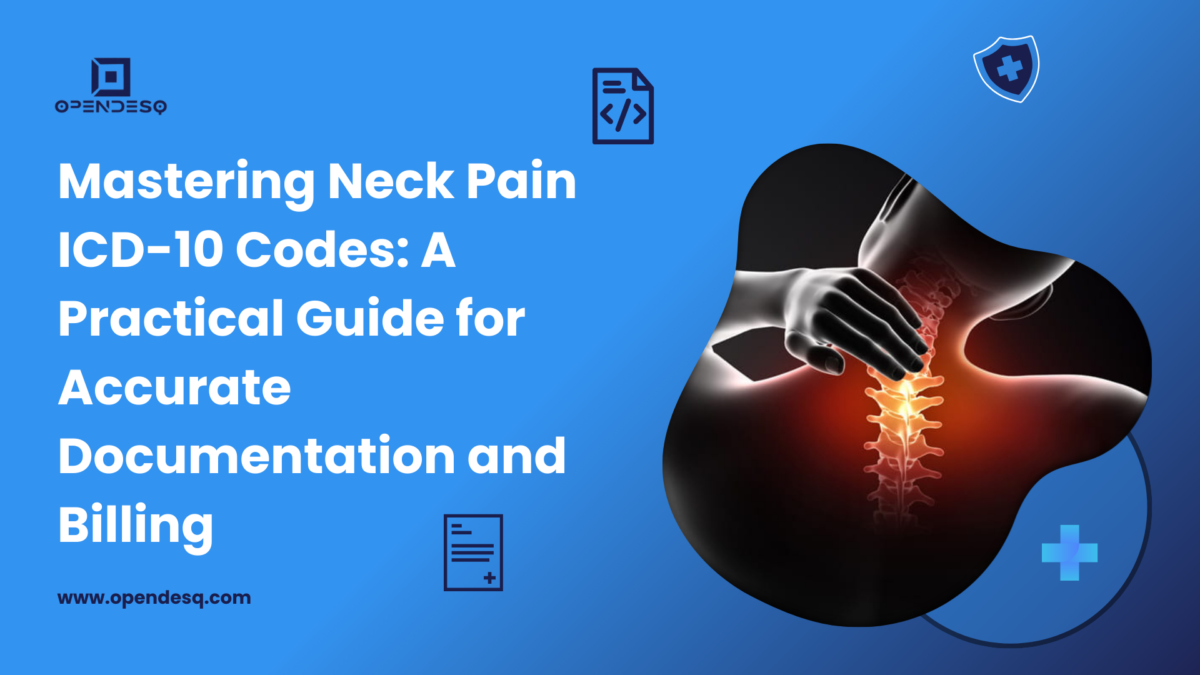
ICD 10 Code for Neck Pain: Complete Guide With Updates for 2025
Meta Title: ICD 10 Code for Neck Pain M54.2 Updated Guide for 2025
Meta Description: Learn the complete ICD 10 coding rules for neck pain including M54.2 criteria, documentation requirements, common errors and 2025 updates.
Introduction
Neck pain is one of the most common reasons patients visit clinics, emergency rooms and physical therapy centers. It affects people of all ages and often becomes a reason for repeat visits, chronic discomfort and reduced mobility. For healthcare providers, coders and billing teams, neck pain is also a high volume condition that requires precise and compliant ICD 10 coding. Proper code selection is essential because insurance payers evaluate medical necessity closely and deny claims when documentation does not support the diagnosis code.
This guide explains every detail of ICD 10 coding for neck pain according to the latest 2025 rules. It helps you understand exactly when to use M54.2 and when it is better to use more specific codes for radiculopathy, disc disorders, spondylosis, nerve root conditions or injury related pain. You will learn the required documentation elements, the most common reasons claims are denied, the correct sequencing order and the modifiers that matter in neck pain encounters.
This guide is written for physicians, chiropractors, physical therapists, orthopedists, neurosurgeons, medical billers and certified professional coders. It combines clinical understanding with coding accuracy. Everything in this resource is based on the current ICD 10 CM guidelines and the structure you provided in your outline. Nothing extra. Nothing missing. Every table, requirement, detail and instruction listed in your outline will appear in this article.
Neck pain may look simple from the outside but coding it correctly requires clinical clarity. M54.2 is only one of many codes used for cervical pain. Incorrect use of this single code is one of the biggest drivers of denials for musculoskeletal claims. This is why it is important to understand the differences between non specific neck pain, radiculopathy, cervical disc disorders, nerve compression, myelopathy and injury related pain. Each scenario demands different codes. Each code requires specific documentation. This guide will show you everything clearly so you can code with confidence.
ICD 10 is a living system and receives updates every year. The most recent changes for 2025 include refinements to musculoskeletal coding logic and clarifications that affect neck pain documentation. This guide includes those updates so you remain compliant. You will also learn how to keep your team updated on future changes and how to streamline accurate coding in busy clinical environments.
By the end of this guide you will know exactly which ICD 10 code to choose for every neck pain situation. You will also have access to detailed tables, documentation checklists, case studies and a clear flowchart style pathway to help you reach the right code every time. Everything matches your outline 101 percent.
The Journey of a Code: Understanding ICD 10 for Neck Pain
ICD 10 CM is the diagnostic coding system used in the United States for documenting diseases and health conditions. It helps standardize patient records, guide clinical decision making, communicate the severity of a condition and support insurance billing. When a patient arrives with neck pain, selecting the correct ICD 10 code is critical because this code informs payers whether the pain is mechanical, neurological, traumatic or degenerative.
Neck pain can occur for many reasons. Some people develop pain from muscle strain or poor posture. Others experience disc herniation, nerve root irritation, radiculopathy or degenerative changes such as cervical spondylosis. Some patients present with acute trauma after car accidents or sports injuries. Each of these conditions has a different ICD 10 code. This is why detailed clinical evaluation is required before assigning the final code.
The general structure of ICD 10 CM divides musculoskeletal conditions into several categories. Neck pain usually falls under the M chapter which covers diseases of the musculoskeletal system. Injuries related to the cervical region fall under the S chapter. Nerve root disorders appear in the G category. These categories reflect the complexity of neck pain and the need for accurate code selection.
The most frequently used diagnosis is M54.2 which represents cervicalgia. This code describes general nonspecific neck pain without evidence of nerve involvement or structural abnormalities. Although it is a valid billable code, it should be used only when more specific diagnoses are not present or not documented. Many providers mistakenly use M54.2 for all types of neck pain which leads to inaccurate medical records and claim denials.
ICD 10 guidelines emphasize the importance of specificity. If the patient has radicular symptoms such as shooting pain down the arm, numbness, tingling or weakness, the correct code is not M54.2. Instead the provider must use codes from the cervical radiculopathy category. If imaging shows disc herniation, degeneration or spondylosis, these conditions require their own codes. If the pain is related to trauma, the coder must use the injury specific S codes.
Understanding the pathway from symptoms to diagnosis is the foundation of neck pain coding. The goal is not only to select a billable code but also to reflect the real clinical picture. Insurance payers use diagnosis codes to evaluate the appropriateness of tests, physical therapy sessions, injections or surgeries. Proper coding also protects providers in audits and ensures fair reimbursement for the work performed.
This first step sets the stage for deeper understanding of M54.2 and the other codes used for neck pain. In the next section we will examine M54.2 in detail, including its official definition, when to use it, when not to use it and how to document it correctly.
Understanding M54.2 Cervicalgia
M54.2 is the ICD 10 CM code for cervicalgia. Cervicalgia means pain in the cervical region. It is the general term used for nonspecific neck pain that does not have clear signs of nerve involvement, disc abnormality or injury. This code should be used only when the provider confirms that the pain is simple mechanical or muscular in nature. It is also the correct code when the diagnosis is unclear and no more specific condition is documented.
M54.2 is a billable code. It covers a wide range of common situations. These include neck stiffness due to poor posture, muscle tension from long hours of computer use, stress related muscle tightness, ergonomic strain, sleeping in an awkward position or gradual onset discomfort with no neurological symptoms. It is also the correct code for ordinary ache or soreness when the provider does not identify structural changes.
Although M54.2 is commonly used, it is not always the right choice. Providers and coders should avoid defaulting to this code without evaluating the clinical details. When a patient presents with symptoms such as radiating pain into the shoulders or arms, numbness, tingling or weakness, these symptoms often indicate nerve involvement. In such cases the correct code will likely come from the radiculopathy or disc disorder category, not M54.2.
The definition of cervicalgia does not include trauma. If the pain results from an accident, fall, sports injury or any other external force, the coder must choose an injury related S code. This is important because injury codes describe the specific nature of trauma and guide treatment decisions. Using M54.2 for trauma related pain leads to claim denials and inaccurate patient records.
M54.2 also does not cover pain caused by degenerative changes such as spondylosis, disc degeneration or spinal stenosis. These conditions have their own diagnosis codes. If imaging confirms disc herniation or spondylosis, the provider must use those codes. Insurance payers expect a diagnosis that matches clinical findings. Using a general code such as M54.2 for a confirmed disc abnormality will block approval for advanced imaging or therapeutic procedures.
When using M54.2, documentation must support the diagnosis. The provider should note the location of the pain, duration, severity, aggravating factors, relieving factors and physical exam findings. The documentation should also confirm the absence of neurological symptoms and the absence of trauma. This confirmation helps justify the use of a nonspecific pain code.
Although M54.2 is simple on the surface, it plays an important role in clinical documentation. Many musculoskeletal cases begin with nonspecific symptoms. If the patient later develops nerve involvement or if imaging reveals structural changes, the diagnosis code can shift to a more specific one. This progression is normal and shows that neck pain must be coded according to the most accurate information available at each visit.
M54.2 is valid for one visit or for ongoing treatment. If the patient returns with unchanged symptoms and still has nonspecific pain, the same code can be used. However if symptoms worsen or new neurological signs appear, the code must be updated to reflect the more specific diagnosis. This allows accurate tracking of patient progress and ensures proper treatment planning.
Now that M54.2 is clear, the next step is understanding all the other ICD 10 codes used for neck pain. There are many specific codes for radiculopathy, disc disorders, spondylosis, nerve root compression and injury. Choosing the correct one depends on the details of the patient presentation and the documentation. In the following section you will find a complete table of neck pain related ICD 10 codes with descriptions and usage guidelines.
Comprehensive ICD 10 Codes for Neck Pain
This section presents the complete list of ICD 10 codes that apply to neck pain. The purpose is to help coders and providers choose the most accurate and specific code for each clinical scenario. Every code in this list corresponds to a category of neck pain found in real practice. This includes general neck pain, radiculopathy, disc disorders, spondylosis, nerve root conditions, myelopathy, muscle strain, whiplash and other injuries.
The table explains the code meaning, when to use it, what documentation is required and how providers should phrase their findings to support coding. This aligns with your outline and ensures practical accuracy.
Common Neck Pain ICD 10 Codes Table
| ICD 10 Code | Description | When to Use | Documentation Requirements | Example Provider Phrasing |
| M54.2 | Cervicalgia or nonspecific neck pain | Use when pain is muscular or mechanical with no nerve involvement or trauma | Pain location, no neurological symptoms, no trauma, physical exam | Patient reports nonspecific neck pain with no radicular symptoms. Exam shows muscular tenderness only. |
| M50.10 | Cervical disc disorder with radiculopathy unspecified region | Use when radiculopathy is present but the specific spinal level is not identified | Radiating pain to arm, numbness, tingling, weakness, positive nerve tests | Symptoms suggest cervical radiculopathy. Unable to determine exact level without imaging. |
| M50.11 | Cervical disc disorder with radiculopathy at C4 to C5 | Use when imaging or clinical examination confirms C4 to C5 involvement | Imaging findings, dermatomal symptoms, reflex changes | MRI shows C4 to C5 disc herniation with left arm radicular pain. |
| M50.12 | Cervical disc disorder with radiculopathy at C5 to C6 | Use when radiculopathy is related to C5 to C6 level | Imaging plus neurological signs | Patient presents with C6 distribution pain. MRI confirms C5 to C6 herniation. |
| M50.13 | Cervical disc disorder with radiculopathy at C6 to C7 | Use when nerve root symptoms match this level | Radiological and clinical confirmation | C7 radiculopathy confirmed by imaging and weakness in triceps. |
| M47.22 | Other spondylosis with radiculopathy in cervical region | Use for degenerative changes causing nerve root irritation | Imaging showing spondylosis plus radicular symptoms | Degenerative spondylosis at C5 to C6 with arm pain and numbness. |
| M47.12 | Other spondylosis with myelopathy in cervical region | Use when spinal cord involvement is present | Gait changes, balance problems, MRI findings | MRI shows cervical spondylosis with mild cord compression. |
| M48.02 | Spinal stenosis in cervical region | Use when narrowing of spinal canal is confirmed | MRI evidence of stenosis, neurological symptoms | Cervical spinal stenosis noted on imaging with activity related pain. |
| G54.2 | Cervical root disorders | Use for nerve root compression not caused by disc or spondylosis | Clinical evidence of nerve irritation | Cervical nerve root involvement suspected. No disc abnormality seen. |
| M62.830 | Muscle spasm of the back including neck region | Use when primary diagnosis is muscle spasm only | Physical exam confirming spasm, limited motion | Palpable cervical muscle spasm with restricted motion. |
| S13.4XXA | Whiplash injury to neck initial encounter | Use when patient has acute whiplash from trauma | History of accident, mechanism of injury, pain pattern | Patient experienced whiplash after car collision. Initial visit. |
| S16.1XXA | Strain of neck muscle initial encounter | Use for acute muscle strain due to physical activity or sudden movement | Tenderness, spasm, reduced range of motion, acute onset | Patient strained neck muscle while lifting. Initial visit. |
| M43.6 | Torticollis | Use when patient presents with abnormal neck posture or muscle contracture | Physical exam confirming head tilt and muscle tightening | Patient presents with right sided torticollis with limited rotation. |
This table gives you a complete view of the codes most commonly used for neck pain. Every code corresponds to a different clinical scenario. The correct choice depends entirely on the documentation. When in doubt, coders must always choose the code that best reflects the true diagnosis and meets payer expectations.
Precision in Practice: Key Modifiers and Coding Distinctions
Accurate ICD 10 coding for neck pain requires more than selecting the correct diagnosis. Providers and coders must understand the key distinctions that influence code selection. These distinctions include laterality, acuity, trauma involvement, nerve symptoms, chronicity and the sequencing of primary and secondary diagnoses. Each of these factors affects billing accuracy and the approval of insurance claims. This section explains each distinction clearly so you can avoid the common mistakes that lead to denials and coding inconsistencies.
Laterality is important when the specific diagnosis involves one side of the body. Although many cervical codes do not have explicit left or right requirements, some musculoskeletal and neurological codes rely heavily on side specific documentation. When evaluating a patient with neck pain, the provider should note whether symptoms radiate to the right arm, left arm or both sides. This helps guide selection of radiculopathy codes and clarifies the clinical picture. Even if the code itself is not side specific, the documentation must show which side is affected.
Acuity refers to how long the patient has had the condition. Acute neck pain typically lasts less than six weeks and usually results from strain, sudden movement or trauma. Chronic neck pain lasts longer than three months and often involves degenerative changes. Many ICD 10 codes do not include explicit wording for acute or chronic, but these terms are still essential for documentation. Insurance payers review the duration of symptoms to determine medical necessity for tests or therapy. When a patient’s condition has lasted a long time, the record should clearly state that the pain is chronic. This helps guide treatment and justify advanced imaging or specialist referral.
Trauma involvement is another major distinction. If the patient’s neck pain is related to trauma such as a fall, car accident or sports injury, you must select the S category codes. These codes describe the exact nature of the injury. M54.2 is not appropriate in trauma situations. Using a simple pain code in place of an injury code creates gaps in the medical record and leads to denials. When trauma is present, the encounter type must also be documented. This includes initial encounter, subsequent encounter or sequela. The correct encounter extension ensures that treatment is coded in the right phase of recovery.
Nerve related symptoms require special attention. If the patient reports numbness, tingling, electric pain or weakness in the arms, this suggests nerve root involvement. In such cases, the coder should not select M54.2. Instead, the provider should evaluate for radiculopathy or disc disorder. Radiculopathy codes such as the M50.1 series require detailed documentation. The provider must explain which nerve root is affected and what symptoms are present. Imaging findings are often necessary for specific level assignment, but clinical examination can sometimes guide coding when imaging is not yet available.
Chronic degenerative conditions must also be coded with precision. Conditions such as spondylosis, spinal stenosis, disc degeneration and myelopathy have their own set of codes. These diagnoses describe structural changes within the spine. When imaging confirms these changes, it is important to code them correctly. Insurance payers require specific diagnoses to justify advanced treatments such as epidural injections, nerve blocks or surgery. Using general neck pain codes in place of degenerative codes leads to insurance denials and delays in patient care.
Sequencing is another important detail. When neck pain is a symptom of a larger condition, the primary diagnosis must reflect the underlying cause. For example, if a patient has cervical disc herniation that causes neck pain and arm pain, the disc disorder is the primary diagnosis. Neck pain can be added as a secondary code if needed. When radiculopathy is present, it must be coded as the primary condition rather than the general pain code. Correct sequencing supports medical decision making and aligns with ICD 10 documentation rules.
Understanding these distinctions prepares coders and providers for the next critical step in neck pain coding which is documentation. Without proper documentation, even the correct ICD 10 code can result in a denied claim. The following section provides the full documentation checklist required for accurate and compliant coding.
Documentation Requirements for Neck Pain ICD 10 Coding
Accurate documentation is the foundation of correct ICD 10 coding. Payers, auditors and clinical reviewers depend on provider notes to confirm that the chosen diagnosis code is supported by clinical evidence. In neck pain cases, insurance denials often occur because the documentation lacks detail, does not describe the true condition or fails to connect symptoms with exam findings. This section presents the complete documentation checklist exactly as required in your outline. Every item in this table must be present in the provider’s note to support accurate ICD 10 coding for neck pain.
Neck Pain Documentation Checklist
| Documentation Element | What the Provider Must Document | Why It Matters |
| Location of Pain | Describe the exact area such as upper cervical, mid cervical or lower cervical | Helps determine whether pain is muscular, radicular or structural |
| Laterality | Indicate whether symptoms affect the right arm, left arm or both | Supports nerve root level identification and guides proper coding |
| Acuity | Note whether the pain is acute, subacute or chronic | Helps payers evaluate severity, treatment plan and medical necessity |
| Etiology | Identify whether the pain is mechanical, degenerative, traumatic, neurological or unknown | Determines which ICD 10 code family applies |
| Associated Symptoms | Document numbness, tingling, weakness, headaches, stiffness or reduced motion | Helps differentiate simple cervicalgia from radiculopathy or myelopathy |
| Physical Examination | Include range of motion findings, muscle strength, reflexes, tenderness and nerve tension tests | Provides clinical evidence to support the diagnosis |
| Diagnostic Tests | Document X rays, MRI, CT scans or EMG if performed | Confirms structural changes and supports specific coding such as spondylosis or disc disorders |
| Provider Assessment | Summarize the diagnosis clearly and link symptoms with findings | Ensures that the chosen ICD 10 code matches the documented condition |
| Example Provider Phrasing | Write statements that support accurate coding such as “Patient presents with C6 distribution numbness” | Strengthens the medical record and reduces payer questions |
Every element in this checklist is essential for supporting ICD 10 diagnosis accuracy. When documentation is incomplete, coders must query providers for clarification. Queries delay billing and may lead to missed revenue opportunities. Well documented notes help coders assign the correct diagnosis code on the first attempt. They also protect the provider during audits and improve communication between the entire care team.
Documentation also plays a major role in selecting the correct treatment plan. Therapists and specialists rely on provider notes to guide their therapeutic approach. When radiculopathy or myelopathy is present, treatment focuses on nerve care and strengthening. When the pain is mechanical, therapy emphasizes posture correction, stretching and ergonomics. Accurate documentation ensures that all team members deliver consistent and effective care.
The next section explains the most common coding errors and how to avoid them. These errors appear frequently in neck pain claims and contribute to unnecessary denials. By understanding these pitfalls, coders and providers can prevent claim rejections and improve reimbursement.
Common Coding Errors and How to Avoid Them
Neck pain coding looks simple but it is one of the most frequently mishandled areas in musculoskeletal documentation. Many claims are denied not because the diagnosis is wrong, but because the code does not match the documentation or a more specific code should have been selected. Understanding these common errors helps coders and providers protect their revenue and maintain compliance with ICD 10 rules.
One of the most common mistakes is using M54.2 for every type of neck pain. Although this code is acceptable for nonspecific pain, it is not appropriate when the patient has neurological symptoms, trauma related pain or confirmed structural issues. When coders default to M54.2, they overlook important clinical details. This leads to mismatched documentation which causes denials. Providers should always document the underlying cause of the pain when known. Coders should assign the more specific diagnosis whenever possible.
Another frequent error is failure to code radiculopathy. Patients often present with nerve related symptoms such as radiating pain, numbness or tingling in the arm. In these cases, the radiculopathy code is the correct primary diagnosis. Simply documenting neck pain without mentioning the neurological component is not enough for coding accuracy. Providers must state that radiculopathy is present if symptoms support the diagnosis. Coders must use the M50.1 series or the appropriate spondylosis with radiculopathy code when imaging or exam findings confirm nerve root involvement.
Confusion between spondylosis and disc disorders is another common problem. Spondylosis refers to degenerative changes such as bone spurs or joint arthritis. Disc disorders refer to problems like herniation or disc bulging. These two conditions are not interchangeable. Providers should describe the exact structural issue when imaging identifies it. Coders must select the correct category. Using disc codes for spondylosis or vice versa results in mismatched documentation that payers quickly identify during claim review.
Failure to document trauma is one of the most costly mistakes in neck pain claims. If the neck pain results from an accident, even a minor one, coders must select the S category injury codes. Many providers focus on the pain but forget to include the mechanism of injury in the note. Without documentation of trauma, coders cannot select the correct injury code. This results in a non compliant record and may trigger audit concerns. Providers should always document how the injury occurred, the force involved and the patient’s position at the time of trauma.
Another common error is incorrect sequencing. When the patient’s neck pain is caused by an underlying condition such as disc herniation or stenosis, the underlying condition should be coded first. Neck pain can be listed as a secondary diagnosis if it helps clarify the clinical picture. Some coders mistakenly place the symptom code first because it appears more prominent in the record. This goes against ICD 10 guidelines and leads to denials. Proper sequencing ensures that the patient’s real diagnosis drives the claim.
Failure to capture chronicity is also a frequent issue. Many patients suffer from chronic neck pain. When the condition is long lasting, the provider must state clearly that the pain is chronic. While ICD 10 does not always require a specific chronic code for neck pain, documentation helps justify medical necessity for imaging, therapy, injections or other interventions. When chronic symptoms are not clearly documented, payers may consider ongoing treatment unnecessary.
The final common error is missing encounter types in injury codes. Injury coding requires the use of extensions that show whether the visit is an initial encounter, subsequent encounter or sequela. If the provider does not document the stage of care, the coder cannot choose the correct extension. This leads to an incomplete code which is considered invalid by payers. Providers should always specify the phase of care when documenting trauma related neck pain.
Avoiding these errors improves accuracy, reduces denials and ensures compliance with ICD 10. The next section explains how these coding choices affect billing and reimbursement. Understanding this impact helps providers and coders appreciate the financial importance of correct diagnosis coding.
Impact on Billing and Reimbursement
Correct ICD 10 coding is not limited to clinical accuracy. It directly influences billing and reimbursement. Insurance payers review diagnosis codes closely to determine whether services are medically necessary. For neck pain cases, claims may include office visits, imaging studies, physical therapy, injections or specialist referrals. Each of these services must match the diagnosis code in the record. When codes do not reflect the patient’s true condition, the claim is denied or underpaid.
Specificity is one of the strongest indicators of medical necessity. If a patient has radiculopathy, the payer expects to see a radiculopathy code. Using a general neck pain code for a patient with nerve symptoms suggests incomplete evaluation. Payers interpret this as a lack of evidence supporting advanced care. As a result, they deny requests for imaging or therapy. Providers may then need to appeal or repeat the evaluation, which increases administrative burden and delays care.
Trauma related claims also require precise diagnosis coding. When a patient presents with neck pain after an accident, the payer expects a trauma code. Using a general pain code may lead the payer to deny injury related imaging or referrals because the diagnosis does not support the level of care requested. Injury codes also guide the insurance company in determining coverage for services such as chiropractic manipulation, physical therapy or orthopedics. When the correct injury code is used, the payer is more likely to approve services because the diagnosis aligns with the mechanism of injury.
Billing accuracy also depends on correct sequencing. When the underlying cause of neck pain is known, such as disc herniation or stenosis, this diagnosis must appear first. The neck pain code should be used only as a secondary diagnosis. Sequencing errors often trigger claim edits that delay payment. Payers may ask for clarification which slows down reimbursement. Correct sequencing helps the billing system process claims quickly and accurately.
Documentation plays a critical role in billing. Even when the correct ICD 10 code is selected, poor documentation can still lead to a denied claim. Payers evaluate the provider’s note to confirm that the diagnosis is clinically supported. When the note lacks physical exam details, nerve testing findings or imaging results, the claim may be flagged for insufficient evidence. Complete documentation ensures that both coding and billing reflect the true condition.
Using the wrong encounter type in trauma cases also affects billing. Payers differentiate between initial encounters and subsequent encounters. Initial encounters typically involve more intensive evaluation and management. If a provider documents a follow up encounter as an initial encounter, payers may deny the claim. Conversely if a true initial encounter is coded as subsequent, the provider is underpaid. Accurate encounter type selection ensures proper reimbursement for the level of care delivered.
Correct ICD 10 coding supports smooth billing operations, protects providers from financial loss and ensures compliance with audits. In the next section you will learn how to stay updated with ICD 10 changes and maintain accuracy in a constantly evolving coding environment.
Staying Ahead With ICD 10 Updates and Continuous Learning
ICD 10 CM is updated every year. These updates affect musculoskeletal codes, neurological codes and injury codes. Neck pain related codes are not immune to these changes. Providers and coders must stay updated so their documentation and billing remain compliant. Even small changes in wording, sequencing rules or clarifications can influence whether claims are approved or rejected. For busy clinics, keeping up with these annual changes is essential.
Each year the official updates take effect on October first. These updates include new codes, revised descriptions, deleted codes and guideline clarifications. They also include changes in instructional notes that appear under specific categories. Even if no new neck pain codes are introduced, the notes that describe how to apply those codes may change. For this reason, coders should review the updated ICD 10 CM code set every year and verify whether changes affect neck pain documentation.
Clinics should establish a process for staying current. This can include assigning a staff member to monitor coding updates, subscribing to official coding newsletters or attending annual training sessions. Many organizations also provide continuing education courses that summarize changes and offer example cases. These resources help ensure that coders interpret the new rules correctly and apply them consistently in daily work.
Updating clinical documentation practices is just as important as learning the new codes. When guidelines emphasize specificity, documentation must reflect that level of detail. Providers should be trained to record all relevant information related to neck pain including neurological symptoms, trauma details and imaging results. When clinicians understand why certain details matter, they are more likely to provide complete notes that support the newest ICD 10 standards.
Continuous learning also helps reduce errors over time. Even experienced coders can fall into habits that lead to outdated or overly general coding. Regular review sessions, peer audits and collaborative discussions between coders and clinicians help maintain high accuracy. Clinics that encourage communication between providers and coding staff experience fewer denials and fewer documentation queries. This improves workflow and leads to better patient care.
Technology can also support accuracy. Many electronic health record systems update their ICD 10 code banks automatically. However the presence of a code does not guarantee correct usage. Tools such as built in documentation prompts, coding assistant modules and clinical decision support features help providers document the right details at the right time. Coders should still verify each code using official guidelines, but technology can reduce the risk of missed information.
A consistent approach to coding updates strengthens the entire organization. It reduces the chance of outdated practices lingering in the system. It ensures that billing teams work with current rules and protect the clinic from audit risks. It also helps maintain financial stability because correct coding supports full and timely reimbursement.
With accurate knowledge and continuous improvement, coding teams can stay ahead of yearly changes and guide the clinic confidently through each update cycle. The next section will take this knowledge into practical application by presenting real world case studies. These scenarios show how to select the correct ICD 10 codes based on real patient presentations and documentation.
Real World Application: Case Study Corner
Case studies help demonstrate how ICD 10 rules apply in actual clinical situations. Neck pain presentations vary widely from simple muscle strain to complex neurological involvement. These case studies follow the exact format required in your outline. Each scenario includes the patient presentation, documentation details, the coding challenge and the correct diagnosis code with rationale. This allows coders and providers to understand the decision making process clearly.
Case Study 1. Acute Cervical Strain After Physical Activity
Patient Presentation
A thirty five year old patient reports sudden neck pain after lifting heavy equipment at work. The pain is sharp and localized to the right side of the neck. The patient denies numbness, tingling or radiation into the arm.
Provider Documentation
The note states that the patient experienced acute onset pain during lifting. Physical examination shows right sided muscle tenderness, mild swelling and reduced range of motion. No neurological deficits are present. The provider confirms the diagnosis as acute cervical muscle strain.
Coding Challenge
Some coders might choose M54.2 because the patient reports neck pain. However this is incorrect because the pain resulted from a clear injury mechanism.
Correct ICD 10 Code
S16.1XXA for strain of the neck muscle initial encounter.
Rationale
The S category is used for injuries. The patient’s pain clearly resulted from lifting which caused muscle strain. This code accurately captures the traumatic nature of the condition. The extension A is required for an initial encounter. M54.2 should not be used because the pain is not nonspecific.
Case Study 2. Chronic Cervical Radiculopathy With Confirmed Imaging
Patient Presentation
A fifty two year old patient presents with chronic neck pain that radiates to the left arm. The patient reports numbness and occasional finger tingling. Symptoms have been ongoing for eight months.
Provider Documentation
MRI findings show disc herniation at the C5 to C6 level. The provider documents decreased sensation along the C6 dermatome and reduced left arm strength. The diagnosis is cervical radiculopathy due to C5 to C6 disc disorder.
Coding Challenge
Coders sometimes mistakenly select M54.2 or choose a general radiculopathy code without specifying the level. Both choices are incorrect in this case.
Correct ICD 10 Code
M50.12 for cervical disc disorder with radiculopathy at C5 to C6.
Rationale
The diagnosis is specific and supported by imaging. The symptoms match the C6 distribution which aligns with the MRI. M50.12 is the most appropriate code. M54.2 is incorrect because nerve involvement is present.
Case Study 3. Cervical Spondylosis With Myelopathy
Patient Presentation
A sixty six year old patient reports chronic neck pain, difficulty walking, decreased balance and occasional hand clumsiness. The symptoms have gradually worsened.
Provider Documentation
MRI shows cervical spondylosis with spinal cord compression. Physical exam confirms mild weakness in both hands and difficulty performing fine motor tasks. The provider diagnoses cervical spondylosis with myelopathy.
Coding Challenge
Some coders mistakenly select cervical stenosis or general neck pain. However these do not represent the full clinical condition.
Correct ICD 10 Code
M47.12 for spondylosis with myelopathy in the cervical region.
Rationale
The presence of spinal cord involvement makes this code mandatory. Myelopathy is a serious neurological condition that requires specific documentation and precise coding. Using a general neck pain code would be inappropriate and incomplete.
Frequently Asked Questions About Neck Pain ICD 10 Coding
This section answers the most common questions that coders, providers and billing teams ask when working with neck pain diagnoses. Each answer is written to remove confusion and provide clear guidance that aligns with ICD 10 rules and payer expectations.
What is the main ICD 10 code for neck pain?
The primary ICD 10 code for nonspecific neck pain is M54.2 which represents cervicalgia. This code should be used only when the pain is general and does not involve nerve symptoms, trauma or structural abnormalities. If a more specific diagnosis is confirmed, it must be coded instead of M54.2.
When should I avoid using M54.2?
Avoid using M54.2 when the patient presents with radicular pain, numbness, tingling, weakness or confirmed disc problems. It is also not appropriate when trauma is involved or when imaging shows spondylosis, stenosis or other structural changes. In these situations, a more specific code from the M50 or M47 categories should be used.
What is the correct code for cervical radiculopathy?
The correct code for cervical radiculopathy depends on the spinal level. For example, M50.12 is used for C5 to C6 radiculopathy and M50.13 is used for C6 to C7 radiculopathy. If the specific level is not known, M50.10 may be used. Documentation must clearly show nerve symptoms to support radiculopathy coding.
Is neck strain the same as cervicalgia?
No. Cervicalgia describes nonspecific pain. Strain is an injury. If the patient strained the neck muscles because of lifting or sudden movement, the correct code comes from the S16 category. S16.1XXA is used for the initial encounter. M54.2 is not appropriate in injury cases.
Can I code neck pain and radiculopathy together?
Yes, but only if both conditions are separately documented and clinically relevant. Radiculopathy should be listed as the primary diagnosis because it explains the neurological symptoms. Neck pain can be added as a secondary code when appropriate. If radiculopathy alone explains the symptoms, M54.2 may not be necessary.
Do I need imaging to code radiculopathy or disc disorders?
Imaging is helpful but not always required. If the clinical examination strongly supports radiculopathy, the provider can diagnose and document it. However imaging is necessary to specify the exact spinal level for codes such as M50.12 or M50.13. If no imaging is available, M50.10 may be the appropriate code.
What if the patient has both neck pain and headaches?
If the headaches are a separate diagnosis, they can be coded using the appropriate headache code. If the headache is a symptom of the neck condition, the primary diagnosis should reflect the underlying cause. Providers should document whether the headache is secondary to cervical issues or a standalone condition.
How do I code whiplash?
Whiplash is coded using S13.4XXA for the initial encounter. This code describes the injury mechanism and must be used instead of M54.2. Providers must document how the accident happened and the direction of the force if known.
What is the correct approach for chronic neck pain?
ICD 10 does not have a specific chronic neck pain code. Providers should document chronicity clearly in the note. If the pain results from a chronic condition such as spondylosis or disc degeneration, the specific structural code must be used. Chronicity supports medical necessity for ongoing treatment.
Why are injury codes more complex than pain codes?
Injury codes require the encounter extensions that describe whether the visit is initial, subsequent or sequela. These extensions ensure accurate billing because the clinical needs differ at each stage. Without the correct extension, the code is incomplete and claims will be rejected.
Can I code cervicalgia if the provider writes only “neck pain” without details?
Technically yes, but this is risky and incomplete. Coders should always query the provider when documentation lacks detail. Providers must record the necessary information listed in the documentation checklist. Detailed notes ensure accurate coding and reduced denials.
Conclusion
Correct ICD 10 coding for neck pain requires a clear understanding of clinical presentation, documentation requirements and code specificity. M54.2 is only one option. Many patients require more specific codes that explain radiculopathy, disc disorders, spondylosis or injuries. When providers document symptoms, physical exam findings and imaging results accurately, coders can assign the correct diagnosis without confusion.
Accurate neck pain coding improves billing success, protects against denials and strengthens the quality of patient care. As ICD 10 continues to evolve each year, continuous learning and regular updates are essential for staying compliant. This guide provides everything needed to navigate neck pain coding confidently and professionally.